Tuesday, September 29, 2009

Painting in Black White, Tadapatri Temples

Generally we would like to see an oil painting in its fullest glory, with colours of rainbow well distributed on the canvas board. Metaphorically speaking the temples of Tadipatri reminds one of the rarest of rare black & white canvas with only a pencil and a sheet of white paper bring out the elements.


What the artisans from the Vijaynagar empire have attempted at Tadipatri is to been seen to be believed. Literally I had to reverse my vehicle and have an argument with my wife, who was reluctant that I should see these temples at any cost. It was worth the disagreement and at the end of the day she was happy that my instincts worked this time around for a change. We were delayed on reaching our sweet home by 1 hour but it was worth it.

LOCATION : Tadpatri is just 50 odd kms from Ananthpur on NH7 with a deviation from the town. But we approached this destination after visiting Gooty, Alampur, Ketavaram, Srisailam, Mahanandi, Yaganti, Belum and Tadpatri was a bonus on the return journey. Just imagine our luck we completed the trip despite the Petroleum Strike called by IOC Officers. This can reveal the dates of our travel for inquisitive readers.


HISTORY : Many a historians consider the two temples of Tadipatri as symbol of an era where artisans have perfected their skills in sculpting. Tiruvenkataswami temple is now known as Chintalaraya temple probably after Krishnadevaraya. This is the primary reason for scenes to be depicted from Mahabharat on the façade of the temple gopurams and citadel. However the balance of the gopuram was dislodged when a powerful lightening struck in 1851 AD due to the absence of earthing or grounding in the structure. The credit for building this temple goes to one Ramalinga Nayudu, a local feudatory of the Vijaynagar Empire.

Chintalraya temple has been resurrected by ASI considering the importance retaining the legacy of such fine piece of sculpting from Vijaynagar era. The Asthana Mantap is fine ornamented as it were with fine sculptures. It stands tall with 40 moulded pillars. The granite are in hues of grayish black. Some of the scenes depicted are King Dasartha performing Ashwamedha yagna, Hanuman talking to Ravana, Sita entering flames, Lord Krishna dancing on the legendary serpent are all depicting of the epics.

The Padmavathi Mantap was generally used as marriage hall for solemnizing marriages in ancient times. This temple can be compared to Virupaksha temple in Hampi but unfortunately the gopuram has collapsed due to elements of nature.


Bugga Ramalinga temple was never completed by the Thimmappa Nayudu due to invasion. Nevertheless Nature too conspired against this edifice by flooding in 1851 AD. The flood waters immersed the temple with waters from river Pennar and the southern tower collapsed under the weak foundation laid.

Bugga means a water spring in Telugu, due to which the temple name was christened as Bugga Ramalingeswara temple. The Linga on the temple premise is perennially fed by the spring.

The temple is built in typical Dravidian style with central columns supporting the roof and the pillars around providing the balance for the entire edifice. The Lion motif on some pillars add to the majestic appeal to the temple. The inscriptions speak of grants made by Achyutraya, Govindayya and Thimmaraya for maintainence and day to day expense of the temple.

Overall the visit to Tadipatri, which was originally a palm growing region due to which the name stuck is literally experiencing the finesse of Vijaynagar architecture. Check out the metaphor painting in black and white at Tadipatri temples.


Gajendragarh Fort got to be Shivaji Maharaj's Legacy


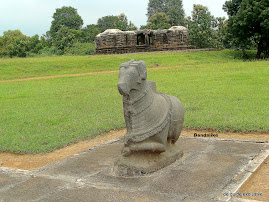
Well nothing like having a date with history and that too with Shivaji Maharaj’s fort after visiting all the royal monuments at Aihole,Badami and Pattadakal. One has to take the Gudlur route from Aihole, which is approx 30 kms and further onwards it is 22 kms one comes into Gajendragarh one of the massive forts. There two more fortifications enroute to this fort along with a Kalkakaleswar temple. The route is filled with caves and hillock, definitely indicating Neolithic mans civilization. Enroute one can witness a statue of unfinished Nandi partially painted with white paint.

The Kalkaleswar temple we avoided it seems to be another historic spot, sheerly because of paucity of time. Kalkaleswar temple is one of oldest Shiva temple, and it is known as Dhakshin Kashi too. One has to trek upto the temple, there is an Udbhav Ling, Veerabhadra temple, in the same premises. There is tank outside the temple which is also known as anthargange, the source of the water must be from the hillock above. There are some amazing myths associated with this temple, regarding the painting of the temple and bell vanishing act. It has to be swallowed with a pinch of salt, unless there are some tribes above the hillock still active.

Windmills : A series of windmills have been set up on the Gajendragarh fort premises, I am sure they have destroyed some portion of the historical monument. Of course this may be with the permission of the jagirdar Ghorpade, who is staying along with his family below the hillock. He may have leased the land to the Windmill owners for generating electricity. A ruined palace of the royalty, which is associated with Shivaji’s feudal lords is situated wherein besides the Jagirdar is currently residing. I hope he can get the palace renovated, it can become a beautiful heritage hotel and earn him life long income.

Gajendragadh were originally home to wolves and hyenas which have been driven out because of hectic high decible human activity. One can find Lambanis decked with fine jewellery If one can get a photo shoot op. please do not hesitate to click a picture. The Lambani costume is a real classic attire.

The fort walls are huge bordering along the Gajendra garh hillock, a water channel is being constructed around the fort hillock, hopefully one should find water next time around and a small bridge may be necessary to cross over. The climb to the fortress is around 140 odd steps. It is just enough for adventurer to scale. On top of the hillock one is welcomed by archway which is the enterance of the Fort. One can find a beautifully etched figure of Shivaji maharaj riding a horse. It might initially looked like a Chinese traveler, on close scrutiny one is bound to connect to Shivaji. Inside the fort one can find 4 watch towers and a huge tank which was meant for storing rain water. It has a couched Nandi and Lion on the wall as if guarding the precious water. The crystal clear water was partially filled due to good rainfall. There is also a small temple on the other side of the Fort. It is surprising that a garrison or buildings is totally absent in the fort. Maybe the limestone construction have collapsed. We met the watchmen who told us there is a nice route by through which one can drive right upto the hillock instead of climbing and another distant watch tower point is lovely spot. He also informed us that there is a dam little away from the fort. Overall it is quite an amazing experience to climb the Fort and have a birds eye view of the Gajendragarh town, which is quite a trading centre. The current palace of the king down on the hillock has some of the items of including a huge dummy tiger which is stuffed, along with some paintings. One has to approach the family diplomatically and one can get a peep into the history of Shivaji Maharaj reign.

A canal is under construction which may pass as a moat to the fort, this might enhance the architecture of the crumbling fort. The approach pathway needs to be cleaned up for a trek. I hope in future the Windmills are restricted and some landscaping is undertaken on fort premises. Overall a visit to Gajendragarh fort gives us the vibes of Shivaji's legacy. Next time around I would not like to miss Kalleswar temple, which too is steeped in mystery and history.

Monday, September 28, 2009

Yaganti Kshetra

Prologue : A group of Cavemen from the Neolithic times were hunting for wild boars and deer for a routine festivity during the full moon nights. They unfortunately lost their way and ran out of food stuffs in the form of banana and papaya. The entire group was tired and thirsty. They were in search of lake to quell their thirst. Suddenly a smart boy Yaga, who was getting inducted into the hunting routine spotted a spring. Everybody enjoyed the sweet water to their hearts content. They looked around the terrain and found it to be an idyllic spot to reside with 4 caves. All the elders patted Yaga on his back. Hurray it was discovery of the abode YAGANTI. It called for a grand celeberation on their return. An announcement was made by the chief that some of the families can shift to this newly discovered YAGANTI, which is blessed with plenty of fresh spring water. In those times land was absolutely free, no need of statutory registration or approval.


History : From the Neolithic mankind the baton was handed over to the Nandas who ruled over this territory, and later the Mauryas took over the reign after defeating the Nandas. Chandragupta Maurya ascended the throne in 323 B.C and spread his wings right upto Shravanbelagola. Later the Guptas and Satvahana dynasties ruled this region. South Indian dynasties of Pallavas and Cholas too reigned for some time, before Hoysalas and Vijaynagar kings took over. The contribution of Raja Raja Chola was limited to the main temple, one of the Gopuram was constructed by the Hoysala Kings, the credit to complete renovation of the temple should go to Bukkaraya in 1345 AD. The addition in the form of Pushkarni was installed by Krishnadevaraya around 1515 AD. After the fall of Vijaynagar empire, the Palegars took over the territory. Than the Bahmani Sultans took over and a Nawab was installed as the governor of the territory. Ultimately the territory passed on to the Nizams of Hyderabad under the British East India company.


Location : Yaganti can be reached through Gooty from Hyderabad towards Banagapalli. It can be approached through Kurnool also. The other route is via Srisailam, Mahanandi, Nandyal and Banagapalli. The third route from Bangalore is to travel via Anantpur, Tadpatri, Belum Caves, Banagapalli and Yaganti. The approach road is from Gooty to Yaganti. The approx distance from Bangalore is 270 kms and Hyderabad it is 340 Kms on NH 7. Yaganti is located exactly 17 kms from Banagapalli if one approaches from Ananthpur or Srisailam route.


Yaganti Kshetra falls under the jurisdiction of Kurnool district. Yagantiswamy is popular for its Shiva temple. A lingam adornes the main shrine. Some claim it was built according to the Vaishnav tradition. Umamaheswar, Parvathi and Nandi are the main deities in the temple. There is a pushkarni for devotees to take bath. It is better to avoid using soap while taking bath. The water is crystal clear and pure because of its flowing nature. Nobody is aware how the pond is blessed with plenty of water even during the summer. Generally the devotees have their bath before proceeding for dharshan.

Shivaratri is celeberated with grandeur and fervour. Devotees from all over AP visit the temple during Shivaratri festivity, which generally held in Feb or March every year. According to a myth sage agastya visited this kshetra and took bath and paid his respect to Lord Shiva. The Nandi seems to be growing in size every year by few mm. It is predicted when the Kaliyug ends Nandi will signify the end of evil domination in this world.

There are 3 cave temples across the spring located on the hillock. The Augustya Muni Cave is quite a steep 120 steps climb. One can find a Devi statue installed which is regularly worshipped. It is real adventure ascent on to the cave temple. The panaromic view of the entire Yaganti temple complex is stupendous from the vantage point on the cave. The steps are safe, one has to be little cautious during the rainy season. Aged people need support particularly when is nearing the peak. There is a resting point in the middle of the cave.

The second cave temple has a lingam and priest is busy helping the devotees with blessing and sermon if required. This cave temple is less steep than the first one. One has to be cautious with elders and children while reaching the top of the cave precincts.

Third cave is an ideal Neolithic mankind dwelling spot, it is accessible through a narrow modified door way. The cave is low level hardly 4 feet in height. It can be claustrophobic for some individuals, the ventilation is provided at the end of the cave. It is better to carry a torch or powerful light. There are lingam to be worshiped along with statue of Shiva.

A huge temple complex adjescent to the main temple complex is under renovation. This temple is quite huge and would be majestic to visit once the renovation is complete. A temple trust has 4 rooms for those who would like to experience Yaganti through the night. The next alternative for stay would be ideally at Kurnool. Gooty and Banagapalli has limited accommodation. Nandayal towards Prakasham district and Tadapatri are other alternative spots for stay.

Overall a visit to Yaganti is a refreshing religious and trekking experience, if one is adventurous one can visit the deserted Nawabs Palace enroute, Fort @ Banagapalli, Mosque within the complex and check out. If one needs further trekking check out the Gooty Fort and Kurnool Fort. Say Yes to Yaganti next time

Sunday, September 27, 2009

MADHUGIRI FORT, A Gowda Legacy

The construction of the original mudfort was undertaken by Raja Hira Gowda in the 17th century around 1670 AD. An interesting incident prompted the Gowda family to considering building a fortress. A stray sheep went missing around the Madhugiri hillock only to return late in the night dripping with water. This was music to the ears since a spring would definitely be welcome sign for rain deficient area. A decision to construct a fortress was arrived and the task was completed. The Gowdas started ruling this region based at Madhugiri Fort.


Genesis of the name Madhugiri is derieved from the Honeybee colonies which were prevalent in those days towards the northern parts of the Madhugiri fortress. There are two large temples located in Madhugiri one is Venkatramana and other is Malleswara. There is also a Jaina temple on the precints of the Madhugiri fort.

In 1678 Gowdas annoyed the Wodeyars of Mysore, and thereby inviting their wrath of non submission of revenue collected being feudatories. The king and the queen were taken prisoners to Srirangapatanam. Once they agreed to dutifully remit the share of the taxes collected they were sent back with honour to occupy their throne in Madhugiri. The Marathas invaded the territory and captured Madhugiri Fort and held it for 7 years. After that Hyder Ali invaded this region and captured the Fort in 1764 and commissioned alteration of the mud fort. He built a huge arch type enterance, which can be seen clearly after the renovation. The entire fort was fortified and watch towers were built in all directions. Secret tunnels were constructed inorder to quickly escape from the enemy in case surprise attacks.

It is rumoured that Hyder Ali collected huge wealth from this Fortress treasury. He threw out all the antiques and collected only gold. Tipu in commemoration of the victory renamed the town Fatehbad. The tax collected amounted to 6 lakh pagodas in this region. The heavy and oppressive tax regime literally ruined the region and people started migrating and ultimately it lost its grandeur, when it was re-captured by Marathas in 1791. But it was re-captured with the help of the British, with bandits who had been exiled. They fought a guerilla warfare and repulsed the Marathas. The fortress and the territory was used to house the prisoners of 1857 sepoy mutiny against the british. Later the British handed over the territory to the wodeyars.

The town Madhugiri never recovered its lost grandeur after the plunder by Marathas and Tipu Sultan. It lost its glory, but the Fortress stands a mute witness to the original glory of the township.

The fort is currently under renovation, we hope the lost splendour of the Fort will be salvaged. Madhugiri fort can be reached from Sira, or from Devandurga, or from Leepakshi, Hindupur, Pavgada.


Madhugiri Fort is truly Gowda familys legacy and behold the local MLA happens to be from the Gowda family.
So the saying goes history repeats itself
LOCATION : There are three routes to reach Madhugiri Fort. One is via dobbaspet or tumkur taking the korategere route and from thereon to Madhurgiri. Next is via Sira towards Madhugiri and last route is from Pavagada to towards Midigishi and Madhugiri. It can a ideal one day getaway from Bangalore covering Shivagange, Gornahalli, Devandurga and Madhugiri.

For photo uploads check this link : http://indiabackpacker.blogspot.com/search/label/Madhugiri%20fort